The demo is the most underused thing in this category. Same mechanic, same interface, stake removed — which makes it the only place you can test a theory, a cash-out rule or a predictor app at zero cost. It is also the cheapest way to settle the question that brings most people here.
The studio publishes one for every title in its catalogue. This is the flagship; the rest are linked from each game’s own page.
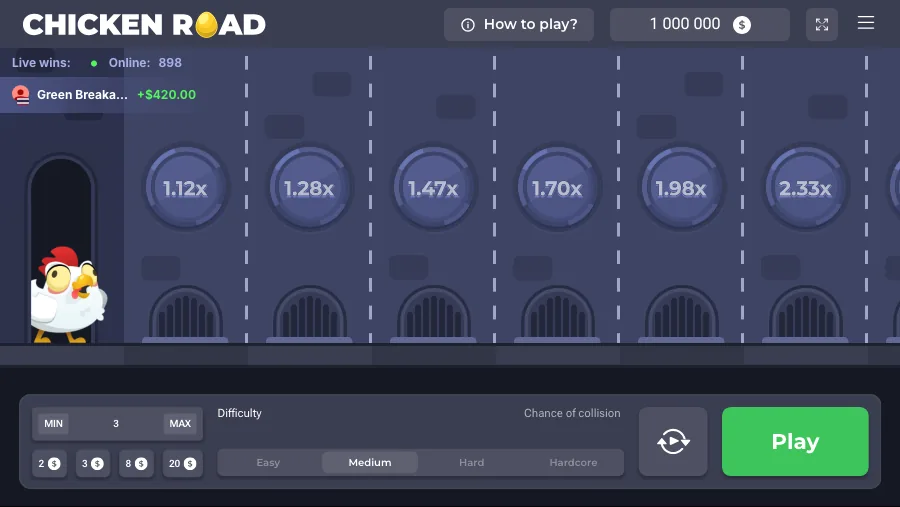
It confirms the title, the studio and the real interface without a stake — the check that caught our own worst mistake, when we described three games from their cover art and two turned out to work nothing like we said.
It will not show you the return rate your casino has configured, and a good run on play money says nothing about the next round with real money in it. The house edge is identical in both.
Not loading? Open it on INOUT Games’s own site instead.
Done with play money? Play for real money
This runs our published model — a 97% return with even per-step risk — not the operator’s live paytable. It is here to make the shape of the decision concrete before money is involved.
Measured, not assumed. INOUT states an RTP of 98% for Chicken Road, and the game prints the multiplier on every manhole cover. We opened the studio’s own demo and read them off the screen: 1.12×, 1.28×, 1.47×, 1.70×, 1.98×, 2.33× on Medium. Those give a survival chance of 87.5% per step — falling to 86.6% by the sixth, so the risk rises slightly as you go. One caveat stands: the same page adds «RTP: Configurable according to operator settings», so 98% is what the studio offers, not necessarily what your casino runs.
Built on the studio’s own published figure — INOUT states 98% for Chicken Road — with one assumption we make openly: an even risk per step, because the per-step chance is published nowhere. And the same studio page adds that the RTP is configurable by the operator, so the curve shows the shape of the offer rather than a promise from your casino.
Find the row where the survival percentage stops feeling acceptable. That is your cash-out step. Write it down before you open the real demo, and then see whether you can actually hold to it — because holding to it is the whole skill.
That the interface works the way this site describes, that the cash-out button is the only decision, and that a predictor app is wrong about as often as chance would predict. All three are worth confirming yourself rather than taking from a page.
Whether the real-money version behaves identically. Demo modes are not independently audited against the live game, and no operator publishes a return figure for either. A hot demo run is entertainment, not evidence.
| Operator | Demo on the crash shelf | Account needed? | Note |
|---|---|---|---|
| Mostbet | Yes | No | Demo covers slots, RNG games and crash; absent for live dealers |
| LuckyStar | Not on house originals | — | Third-party crash titles sometimes have it, its own do not |
| 1win | Varies by title | — | Deep crash library; check the individual tile |
Demo mode costs an operator nothing and removes a barrier to play. When it is missing specifically on house-made originals — the titles carrying the best margins — the straightforward explanation is that those games are not meant to be examined closely before a deposit.
Look at the balance. A suspiciously round starting number almost always means demo chips. People have posted screenshots of wins they never made, and the giveaway was always a balance that started at exactly 1,000 of something.
Because you are not signed in. Demo is the default for an unauthenticated visitor at most operators. That is a session problem, not a missing balance. More on that.
It is designed to be enjoyable. Free play in any casino game tends to feel better than the paid version, and that is not a conspiracy — it is what happens when losses cost nothing. Judge the mechanic in demo. Do not judge your luck.
It is the cheapest verification available in this category, and it verifies a narrower thing than most people assume.
Loading the demo shows you the real interface, the real pace and the provider label. That settles the commonest confusion in this genre — whether the thing in front of you is the game you were looking for or one of the seventy other chicken titles.
We assumed a whole family of titles shared one mechanic and were wrong about two of the three we eventually watched. A demo takes a minute and answers that question directly, where a name and a piece of cover art actively mislead.
The studio states the figure is configurable by the operator. A demo running on the studio’s own site need not match the configuration in a casino lobby, and neither publishes which setting is in use.
Whether verification is slow, whether the corridor is documented, whether money comes back — none of that is visible from free play. The demo is the game; the risk is the operator.
Free play runs in a browser. Any page insisting you install something to try the game is describing a different product or selling one. Including one site we traced that impersonates the studio and never serves a file at all.
The studio puts a Play Demo button on every catalogue page — all forty of them. Most lobbies offer one too. An operator that offers no demo on any title in this category has made a decision about what it wants you to find out before funding an account.
Free play pays out on a balance that costs nothing, and a run of luck in it means precisely nothing about the next round with money in it. The house edge is identical and your memory of the demo is not.
A demo is most useful as a rehearsal for the decision you will have to make with money.
Pick a step, bank there every round for twenty rounds, and notice how it feels to walk away from a climbing number. That is the skill the game actually demands, and it is the only one it rewards.
Losing one step past your target is how most rounds end. Seeing your own reaction to it with nothing at stake is worth more than any strategy page.
Rounds take seconds. A demo is the safest place to find out how many decisions you make in ten minutes, and the number is usually surprising.
If a review described controls or a feature the demo does not have, the review was written from somewhere other than the game. That is a useful thing to learn about a source before you trust its numbers.
Whether to play for money is a different question from whether you enjoyed the demo, and it should be answered with the operator’s licence and withdrawal corridor in front of you rather than with the game still open.
The demo is the same game with the stake removed, and the correct place to learn the one decision Chicken Road offers. Use it to practise stopping on a planned step, and to test any system somebody sold you — both free here and expensive anywhere else. An operator that hides demo mode on its own originals has told you something worth hearing.

