The Chicken Road game is a crash title by INOUT Games. A chicken crosses a road, every step it survives raises your payout, and one wrong step takes the lot. That is the entire product, and everything else written about it is commentary on those two sentences. This page is the commentary worth reading.
A round begins when you set a stake and press start. The chicken moves forward one step at a time. Each completed step multiplies what you stand to collect and carries a fresh chance of ending the round with nothing. You hold one button and one decision: stop, or go again.
The studio’s own integration code files it under crashGame_results — the same bucket as Aviator and every other multiplier game where you cash out before a crash. The chicken is a costume. Underneath it is a crash game, and if you have played one you already know this one.
Crash games have no spin, no reels, no paylines and no bonus round. There is nothing left to learn about the game after the first five minutes. What remains is a single decision repeated, and the quality of that decision is the only thing separating one player from another.
Not a slot, despite an award banner calling it one. Not an app — the studio ships no installer. And not a game of skill: nothing you learn changes the odds of the next step, only what you do around them.
Your payout rises step by step in a straight-ish line. Your chance of still being alive falls step by step as a curve. The two lines cross early, and after the cross every extra step costs more in probability than it adds in money.
We opened the studio’s demo and captured the screen on 16 August 2026. Two things on it are not in the studio’s specification sheet.
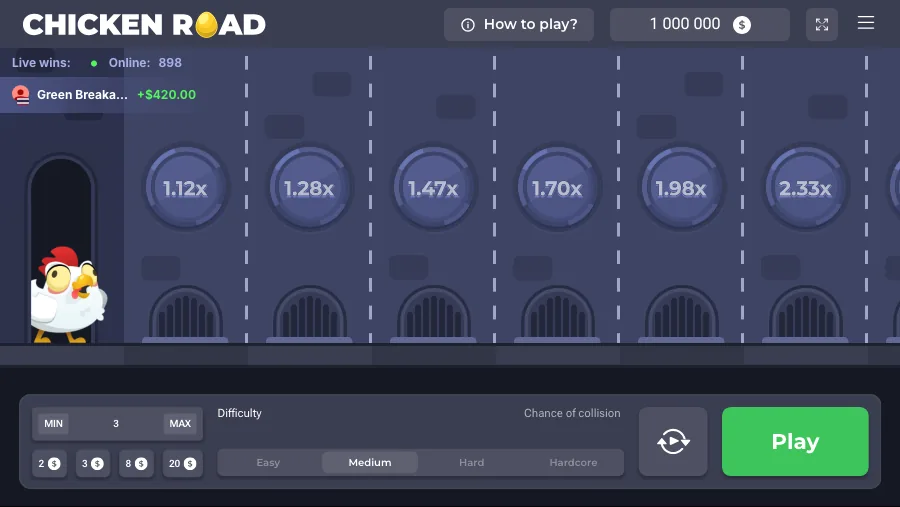
We wrote that difficulty levels are published for Chicken Road 2.0 and not for the original. The specification sheet does only list them for the sequel — but the original game has Easy, Medium, Hard and Hardcore on screen. The right statement is that the studio does not print them in the spec table, not that the game lacks them.
The step table on this page used to be built on an assumption: an even risk per step. The printed multipliers let us compute the real one. A survival chance of 87.5% on the first step, drifting to 86.6% by the sixth — so the risk does not stay even, it rises slightly as you go.
Every step multiplies the payout by roughly 1.14 and cuts your chance of keeping it by about an eighth. That trade is identical at every step, which is exactly why there is no clever place to stop — only a place you decided on in advance.
Because we spent a week describing games from their cover art and got three of them wrong. A screenshot of the running game is the cheapest evidence in this category and almost nobody publishes one. The corrections that taught us that.
No download, no account, and the same interface you would meet at a casino. It is the cheapest check in this category and almost nobody mentions it exists.
It confirms the title, the studio and the real interface without a stake — the check that caught our own worst mistake, when we described three games from their cover art and two turned out to work nothing like we said. On this game specifically it also shows you the multiplier printed on every manhole cover and the four difficulty levels — neither of which appears in the studio’s specification table.
It will not show you the return rate your casino has configured, and a good run on play money says nothing about the next round with real money in it. The house edge is identical in both.
Not loading? Open it on INOUT Games’s own site instead.
Done with play money? Play for real money
Pick a step, bank there every round for twenty rounds, and notice how it feels to walk away from a climbing number. That is the only skill this game asks for, and the demo is the one place it costs nothing to fail at.
Losing one step past your target is how most rounds end, and it reads as almost winning rather than as losing. Seeing that with nothing at stake is worth more than any strategy page.
If a review described a control or a feature the demo does not have, it was written from somewhere other than the game. That tells you something about the source before you trust its numbers.
Which return rate your casino has configured. The studio states 98% and adds that the operator can change it, and no operator publishes its setting. The demo shows you the game; the casino decides the price.
Every step buys you a bigger number and sells a piece of your odds. Read this table once and you understand Chicken Road better than most people who have played it for a month.
Measured, not assumed. INOUT states an RTP of 98% for Chicken Road, and the game prints the multiplier on every manhole cover. We opened the studio’s own demo and read them off the screen: 1.12×, 1.28×, 1.47×, 1.70×, 1.98×, 2.33× on Medium. Those give a survival chance of 87.5% per step — falling to 86.6% by the sixth, so the risk rises slightly as you go. One caveat stands: the same page adds «RTP: Configurable according to operator settings», so 98% is what the studio offers, not necessarily what your casino runs.

Look at step four. The payout has risen by about half, and the chance of getting there has fallen to roughly three in five. Past that point you are paying more probability per step than the multiplier gives back. Every strategy sold in a messaging app is an attempt to talk you past that line.
Multiply the payout by the chance of reaching it at any row and you get the same number. The row you choose changes how the money arrives — often and small, or rarely and large — never how much of it does. The full table, priced.
We went through INOUT’s own site and took down everything it states about this game. The short list below is the complete set of facts the developer is willing to put its name to.
chicken-road-twoINOUT publishes 98% for Chicken Road on its own catalogue, alongside the volatility, the bet range and the release date. That is a high figure — at the top of this whole genre.
One line on the same page complicates that number, and it is the most useful sentence the studio has published: «RTP: Configurable according to operator settings». So 98% is what INOUT offers, not necessarily what your casino runs — and no operator we checked publishes which setting it uses. The honest summary is that a figure exists, it is high, and it is adjustable by somebody whose adjustment you cannot see.
Chicken Road 2.0 is published at 95.5%, and so are the reskins — Ice, Vegas, Gold, Chicken vs Zombies. Chicken Shoot is 94%. The first version is the most generous thing the studio has made, which is the opposite of what a version number usually implies.
This site previously said INOUT published no return figure at all. That was our error: we had crawled the studio’s shop-window domain, where game pages sit behind a redirect, and never reached the catalogue where the specifications live. Corrected on 15 August 2026, with the source named above so you can check it.
We checked it rather than repeating it. The Anjouan register lists ALSI-202506032-FI2 against IOGr B.V. — a b2b licence covering inout.games. The b2b part matters: it is the licence of a studio that sells games to operators, which is exactly why your money never sits with INOUT and always sits with a casino.
The register shows the status as Valid and the expiry as 25 June 2026, which has passed. We print both fields as published. And a licence of any kind does not mean an auditor tested the random number generator.
Fifteen studios read on their own sites in August 2026. The return rate is the only number all of them can be compared on.
| # | Game | Studio | Return rate |
|---|---|---|---|
| 1 | Chicken Road | INOUT Games | 98% |
| 2 | Aztec Plinko | INOUT Games | 98% |
| 3 | Rock Paper Scissors | INOUT Games | 98% |
| 4 | Chicken Subway | 100HP Gaming | 98% |
| 5 | Landing Chicken | Funky Games | 98% |
| 6 | Joker Poker | INOUT Games | 97.95% |
| 7 | Hamster Run | INOUT Games | 97% |
| 8 | Twist | INOUT Games | 97% |
| 9 | Twist X-mas | INOUT Games | 97% |
| 10 | Chicken Rush | BGaming | 97% |
| 11 | Chicken Rush 2 | BGaming | 97.00% |
| 12 | Chicken Shot | BGaming | 97.00% |
| 13 | Chicken Pirate | 100HP Gaming | 97% |
| 14 | Chicken Ways | SmartSoft Gaming | 97.00% |
98% is the highest stated return in the genre, shared with Aztec Plinko and Rock Paper Scissors from the same studio. Nothing in this category states more, and the figure comes from the developer rather than from a listing site.
A maximum win. Fourteen of the fifteen studios publish one — Turbo Games ×1,000,000, BGaming in euro amounts down to €250,500, Evoplay €750,000, 100HP $10,000. INOUT publishes none, for any of its forty titles. The game with the best stated return is the one that will not tell you what it can pay at most.
The ceiling. A return rate is a long-run average you will never observe in a session; a maximum win is a hard bound you can hold a marketing claim against. That is exactly why the pages promising you a specific big number are almost always about the games where no ceiling is published.
The studio’s own page adds that the return is «configurable according to operator settings», and Million Games publishes one title at three different rates. Across this genre the number is per-deployment, and the deployment belongs to your casino.
Some games in this genre let you check that the result was committed before you played. This one does not.
Across forty titles there is no round ID, no salt and no hash to check. Any page telling you Chicken Road is provably fair is describing something the studio does not offer.
100HP’s Tappy Bird publishes an encrypted hash of the result when the round starts and reveals the salt when it ends, so you can recompute it yourself. Its rules panel also states plainly that «before the game round begins, its final result is generated randomly». How that works.
It would prove the outcome was fixed before you decided when to cash out, rather than adjusted afterwards. It would not tell you the game is generous: a provably fair game with a house edge is still a game with a house edge.
Not as evidence of anything dishonest. Most games in this category offer no verification and are run by licensed studios under licensed operators. It simply means the only thing standing behind the result is the regulator, and that is worth knowing when you choose where to play rather than what to play.
Chicken Road is provably fair.
The studio publishes no such scheme for any of its forty titles — no round ID, no salt, no hash. The claim appears on pages that also quote maximum wins the studio never published. Where provable fairness genuinely exists in this genre, the game shows you the hash before the round and the salt after it.
Since you cannot verify the round, verify the operator: find its licence number in the regulator’s own register rather than in its footer. We ran that on four operators and three returned something not mentioned on their own sites. The procedure.
Searched in the lobby, not read off a marketing page. Two are confirmed, and the rest of the list is on the casinos page with what each check found.
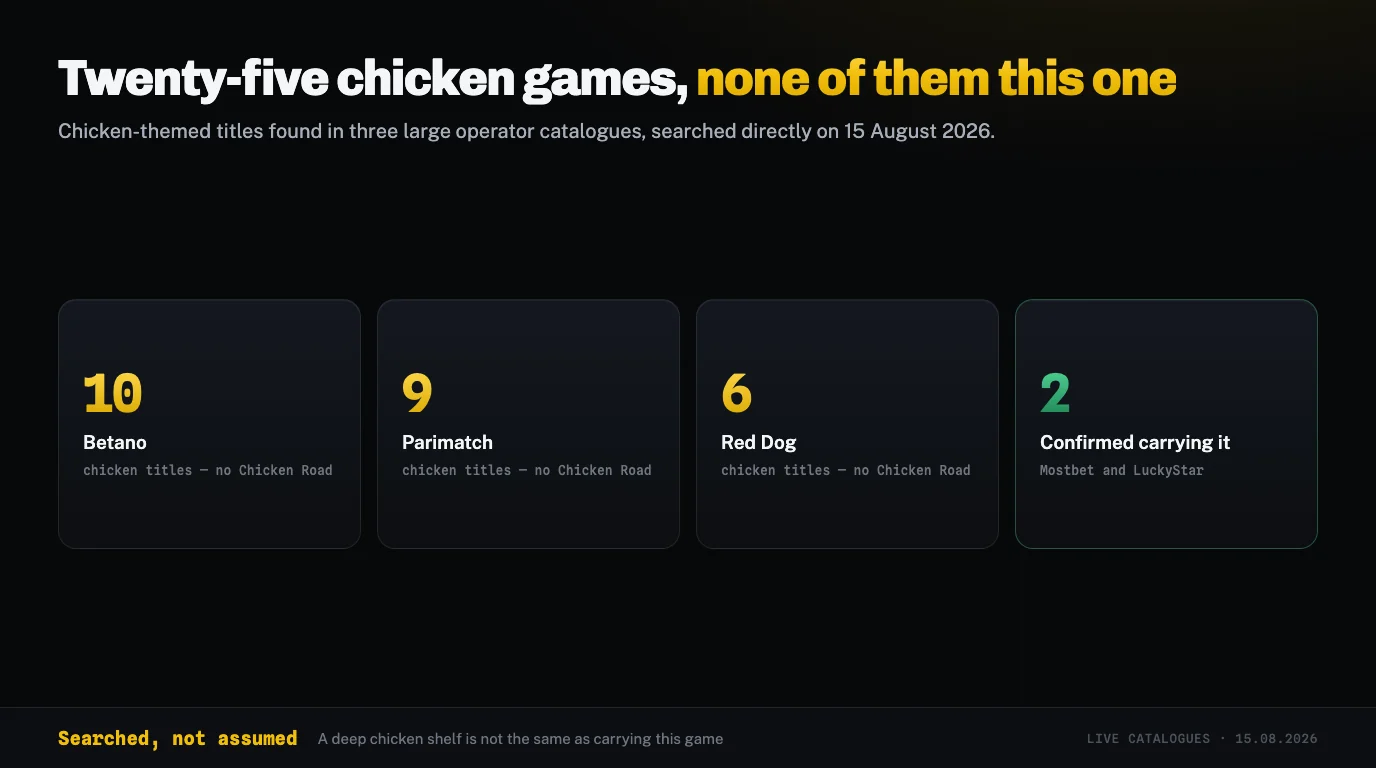
We searched the operator’s own catalogue for the title and found it, rather than trusting a page that lists a hundred studios. Where a casino carries chicken games but not this one, we say so — Red Dog has six chicken titles and eight Plinko builds and none of them is this game.
Five more operators appear on INOUT’s own client list. That means the studio’s games are integrated somewhere in their catalogue. It does not mean this title is in the lobby, and it says nothing about whether your country is accepted or whether the money comes back.
The game plays identically wherever you find it. What differs is the licence, the withdrawal corridor and how long verification takes — all of which belong to the operator. The four checks, and what each returned.
This single mismatch generates most of the confusion around the game, and it takes one paragraph to clear up.
There are two different chicken games and I need to work out which one I played.
There is one game with two builds. INOUT’s shop window lists only Chicken Road 2.0, while the version sitting in most casino lobbies is the original. Both are the same studio, the same mechanic and the same chicken.
Read the title on the game card. If it says 2.0, you have the newer build. If it says nothing, you have the original — which is also the version most of the world means when it searches for this game.
A version number implies a release order, not that one is a copy. If you opened the game inside a casino and it did not say 2.0 anywhere, you played the real thing. The full comparison.
Studios refresh their marketing faster than operators refresh their lobbies. The integration inside a casino was signed earlier and keeps serving the build it was signed for. Nothing sinister, and it explains almost every «which one is real» argument on the internet.
Then the version number is not it. Start with the trust page, which separates the genuine game from the earning apps built around its name.
We searched operator catalogues directly rather than reading their marketing pages. The result is more interesting than a list of casinos.
| Operator | What the catalogue returned | Chicken Road itself |
|---|---|---|
| Mostbet | Search returns the game; crash shelf is deep | In the lobby |
| LuckyStar | Chicken Road 2 sits first in its own Best Games shelf | In the lobby |
| 1win | Seven chicken-themed fast games, including Chicken Subway | Family only |
| Red Dog | Six chicken titles, eight Plinko builds, three Aviamasters | Not this title |
| Parimatch | Nine chicken titles, four Plinko builds | Not this title |
| Betano | Ten chicken titles — catalogue shared with Parimatch | Not this title |
Red Dog, Parimatch and Betano all carry deep chicken shelves. None carries Chicken Road by INOUT. If you searched a major operator for «chicken» and came away with Chicken Drop or Crazy Chickens and a feeling that something was off — you were right.
Operators that went out and licensed six to ten poultry titles clearly wanted the category. They still do not have this game. That is a fact about where INOUT has placed its integrations, not about the quality of those casinos.
Mostbet, where a live catalogue search returned the game with the counter at its ceiling, and LuckyStar, where Chicken Road 2 is promoted on the front of the lobby. Both have real drawbacks documented on their own pages — an expired licence in one case, no two-factor authentication in either.
Every operator here is judged against four checks and keeps its failures printed on its page. The method.
The name reached India and Pakistan by ear before it reached anyone in writing, so a lot of people type what they heard.
If you typed chicken roll, chicken rod, chicken rode, road chicken or just chicken game, you were looking for Chicken Road and you have found it. There is no separate better version hiding under one of those names, which matters because that is exactly what the app stores would like you to believe.
Where the spellings are used. They are typed almost entirely in India, Pakistan and Bangladesh and effectively nowhere else on earth — what happens to a name that spreads by word of mouth among speakers of Hindi and Urdu, and never happens to a product with real global distribution.
Chicken Roast is a genuinely separate Android title, distributed outside Google Play. Lucky Chicken is a name with several unrelated things behind it and no single product. We had both filed as mishearings until we checked properly, and corrected it.
Around the real game sits a shelf of arcade clones, earning apps and predictor subscriptions using the same words. Every chicken game, sorted by what it actually is.
None of these improve your odds. All of them stop the avoidable losses, which is a different and more achievable goal.
It does not make the game profitable. Every step is priced slightly below its true odds, and that shortfall is the operator’s margin. Discipline changes how long your money lasts and how much of the loss was avoidable. It does not change the direction.
Interest in predictors and hacks is very often a symptom rather than curiosity — people start hunting for a system at the point where losses have become a problem to solve. If that is where you are, this page is more useful than any strategy.
Chicken Road is a straightforward crash game wearing a cartoon. The mechanic is honest and takes five minutes to learn; the ecosystem around it — predictor apps, fake installers, guaranteed-win channels — is where the money actually gets taken. Learn the step trade, pick your cash-out number before the round, open the game from a casino lobby rather than a store, and you have removed every avoidable risk this game carries. What remains is the risk you chose, which is the point of playing.