Tappy Bird is 100HP’s step game, and it does two things nothing else in our coverage does: it prints its maximum win on the track before you bet — ×62.12 for a completed run — and it publishes a hash before the round and a salt after it, so the result can be verified with any online calculator. INOUT offers neither on any of its forty titles.
A pixel bird flies through gaps between pipes. Every gap cleared is a step, every step lifts the multiplier, and one collision ends the round. There is a cash-out button, and pressing it at the right moment is the only decision in the game. If that sounds like Chicken Road with wings, that is because the underlying bet is the same one.
This is the part worth stopping on. Easy is 24 steps. Hard is 14. Every other title in this genre that offers difficulty levels makes the game faster or the traffic denser; this one makes the run shorter. A shorter run with the same ceiling means each step has to be worth more, and it means the whole decision compresses into fewer moments.
×62.12 is printed on the track next to a trophy: that is what a completed run pays, and the studio says so plainly — pass every obstacle and reach the finish and you get the maximum win. Separately, the limits panel states a maximum payout of $10,000 in cash, against a bet range of $0.10 to $150. The multiplier caps the run; the $10,000 caps the money whatever the multiplier does. We had those two conflated on an earlier version of this page.
The round-detail panel exposes a round ID, a salt and a hash alongside the multiplier and the result. That is a provably fair scheme: it lets you confirm the outcome was committed before you played rather than decided afterwards. INOUT publishes no such scheme for any title, which is why our page on that studio says any claim of provable fairness for Chicken Road was invented.
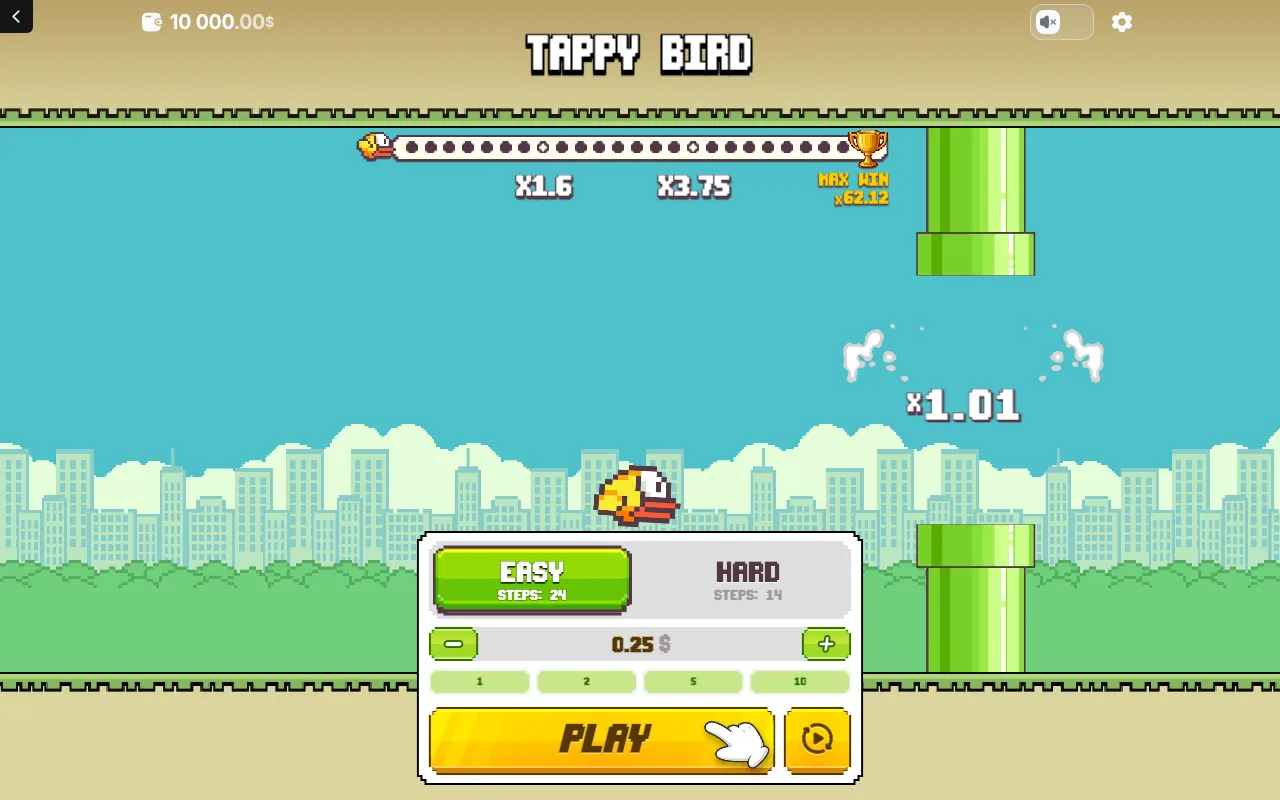
On the studio’s own site. Worth loading for one specific reason: the maximum multiplier is printed on the track before you bet.
It confirms the title, the studio and the real interface without a stake — the check that caught our own worst mistake, when we described three games from their cover art and two turned out to work nothing like we said. The round-detail panel is also where the salt and the hash live, so the demo is where you can practise verifying a round before any money is involved.
It will not show you the return rate your casino has configured, and a good run on play money says nothing about the next round with real money in it. The house edge is identical in both.
Not loading? Open it on 100HP Gaming’s own site instead.
Done with play money? Play for real money
Not our inference. The studio’s own rules panel, in its own words.
That is the studio describing its own game. The outcome of the round — how far the bird gets — is fixed at the moment you press play, before you have made a single decision about when to stop.
It removes it. You are not racing a live process and judging the moment; you are revealing a result that already exists, and choosing how much of it to take. Cashing out early does not dodge a crash that was going to happen — it collects part of a number that was set in advance.
The studio publishes an encrypted hash of that result when the round starts, and reveals the salt when it ends. Recompute the hash yourself — the rules panel says any online calculator will do — and you can confirm the result was committed before you acted rather than adjusted afterwards.
That the game is generous. A provably fair game with a house edge is still a game with a house edge; verification is about honesty of process, not about price. Nobody should read a fairness badge as a statement about what the game returns — especially here, where the return rate is not displayed at all.
The studio states that if the gaming equipment or software malfunctions, all bets and payouts are cancelled and affected players are reimbursed within an hour. It also states the operator is not responsible for a bet lost to your own connection dropping. Both are worth knowing before rather than after.
Open the bet history or the leaderboard, click the shield on a round, and copy the salt and the hash from the round-information panel. Paste them into the game’s own fairness check, or into any hash calculator. If they match, the result you were shown is the result that was committed. That check takes under a minute and almost nobody runs it.
Found in the studio’s own configuration file rather than inferred.
The configuration the game loads on startup carries a flags block, and inside it rtp: false. The software supports showing a return rate. In the build we could reach, it is switched off.
Elsewhere on this site a missing return rate means the studio never printed one. Here it means the studio built the capability and a particular deployment disabled it — so the number exists somewhere, and whether you see it depends on how your casino configured the game.
INOUT’s own page says its return is «configurable according to operator settings». Million Games publishes one title at three different return rates. Now a third studio ships a switch for whether the figure is shown at all. The pattern across this genre is not that figures are unknown — it is that they are per-deployment, and the deployment is the operator’s.
Quoting an RTP for this game. Aggregators publish one. We could not read it from the studio, and a figure from a listing site is exactly what the rest of this site exists to warn you about.
Before the round, the server commits to a result by publishing its hash. Afterwards it reveals the salt, and you can recompute the hash yourself and see it matches. It proves the outcome was not chosen after you decided when to cash out. It does not prove the game is generous, and it says nothing about the house edge — a provably fair game can still be a bad deal.
The third time in this project that we have mistaken one host for a whole company.
That six titles attributed to 100HP had no page on the studio’s domain, Tappy Bird among them, and that only aggregators printed figures for them.
The studio runs a marketing site and a separate demo lobby on a different domain, with the game itself served from a third. We had checked the first, found nothing, and drawn a conclusion about the company. A reader sent a working address and the game loaded immediately, complete with a configuration file and a translation file we could read.
We said INOUT published no return rates — wrong domain. We said Pascal Gaming’s Chicken Revenge did not exist — our own reviewer found the page. Now this. Every one of them is an absence of evidence promoted to evidence of absence, and every one of them read as confident research on the page. The full log.
The five remaining 100HP titles are now described as unknown to us rather than undocumented. That is weaker and it is accurate: the demo lobby returns 200 for every address including invented ones, so a slug that fails to load proves nothing at all.
Send it. This page is the direct result of somebody doing exactly that, and it is now one of the better-evidenced pages on the site.
Tappy Bird prints its ceiling on the track and lets you verify the round afterwards, which puts it ahead of the game this site is named for on both counts. What it does not show is a return rate — and the reason is unusually legible: the studio built the display and this deployment switched it off. The page exists at all because we told readers this game was undocumented, one of them proved otherwise, and that correction is worth more to us than the page.

